
A Memorial, and Defense Talk

"We are the family of Major Sheila Har-Even RIP.
On 07.10.2023 was Shiloh commander of the Nahal Oz region, company commander in "Golani". At 06:29 the gates of hell were opened.
At 08:23 the miracle of creation that was our Shiloh - fell in battle, aged 25, after in his short life had done so much - to be, to do, to love, to lead, and to influence others.
During the
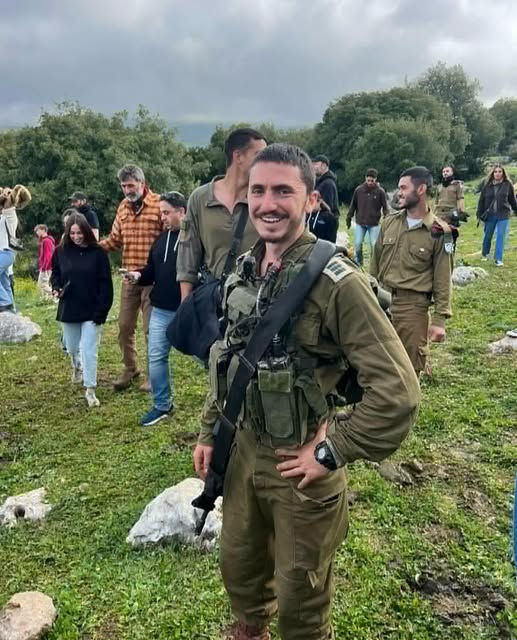
heroic battle, Shiloh did the impossible - commanding the section, commanding the company, commanding the battles in the attacked kibbutzs, commanding the tiger from whom fought with a team of soldiers, finalized the plan to recapture the position of the River of Oz to rescue the trapped soldiers, and storming with his soldiers. In the last 40 minutes he was already badly injured, without a hand and with a artery blocker, but he refused to give up. Shiloh's command had a few powers in number in armor and intelligence, but Shiloh and his soldiers - with determination, without fear, and with self-sacrifice - saved the lives of thousands in the River of Oz sector and settlements the terrorists intended to reach. 16 of Shiloh's soldiers fell along with him.
On the courage, the heroism, the resource, the force, the command, taking responsibility, and everything in a cool breeze and when he is already seriously injured and refusing to evacuate - Shiloh was recommended by the military research of the battle of the Nahal Oz to decorate the heroism.
On 07/18 Sheila was supposed to celebrate his 28th birthday. This is already the third year that we are not allowed to celebrate with him, and so we chose to mark this special day in a way of remembrance and memory."
Strengthening Israel’s Defensive Capabilities
By Justine Hemmestad
The continued development of Israel’s air-defense capabilities has become a central focus. The recent Iron Dome testing was conducted not only to evaluate existing capabilities but also to incorporate lessons learned from combat conditions and prepare for future scenarios involving larger and more advanced attacks.
The Israel Missile Defense Organization (IMDO) stated that the testing examined improvements designed to strengthen Iron Dome’s ability to respond to a variety of threats, including rockets, cruise missiles, and unmanned aerial vehicles. The evaluation also focused on the system’s ability to manage situations involving a high volume of incoming fire, reflecting concerns about the possibility of sustained missile and drone attacks.
The testing included the operational integration of Iron Beam, a high-power laser defense system designed to work alongside Iron Dome. Iron Beam was developed by the Directorate of Defense Research and Development’s research and development unit as a complementary capability intended to expand Israel’s ability to respond to aerial threats.
The integration scenarios tested how Iron Beam could operate within the Iron Dome battle management center, allowing the two systems to work together as part of Israel’s broader missile-defense network. The Israeli Ministry of Defense described the advancement as an additional layer of protection designed to strengthen Israel’s readiness amidst threats to its security.
The improvements represent part of a long-term effort to preserve Israel’s defensive and technological advantages. The goal is to continue increasing the effectiveness of Israel’s air and missile-defense systems while preparing for future threats.
Moshe Patel, director of the Israel Missile Defense Organization, said the defense establishment had faced an unprecedented operational reality during the war, including repeated barrages that required flexibility, rapid response, and continued support under difficult conditions.
“The Iron Dome system remains a central pillar of Israel’s multi-layered defense concept for countering missiles and ABT threats,” Patel said. He emphasized that the recent testing also demonstrated the importance of integrating Iron Beam into the Iron Dome command-and-control system, increasing the capabilities available for protecting Israel’s civilian population.
Patel stated that the defense establishment is also working to accelerate interceptor production in both Israel and the United States. According to his statement, increasing production capacity is intended to strengthen readiness for a range of possible scenarios.
He added that Israel continues upgrading Iron Dome and Iron Beam capabilities across multiple areas, including air, land, and sea-based defense systems. The stated objective is to increase the effectiveness of Israel’s defensive network and help maintain civilian normalcy even during periods of active conflict.
Rafael Advanced Defense Systems CEO Yoav Tourgeman also highlighted the importance of the Iron Dome upgrades and the integration of Iron Beam. Tourgeman said Rafael was proud to complete another advanced test series in which new capabilities were evaluated under complex conditions.
The testing included scenarios involving the integration of Iron Beam, which Rafael developed and delivered to the Israel Defense Forces several months earlier. Tourgeman described Iron Dome as a central component of Israel’s defense system and said the continued improvements were designed to help the system remain prepared for future threats.
The test series was conducted in cooperation with the Israeli Air Force, the Israel Missile Defense Organization, and Israel’s test and evaluation corps. Tourgeman said the results represented an expansion of the system’s capabilities that would be incorporated into the IDF’s air-defense network.
He credited Rafael’s scientists and engineers, along with defense industry partners, for continuing to develop advanced defensive technologies designed to protect Israel’s citizens and strengthen national security.
As the conflict with Iran continues, Israel’s defensive strategy remains centered on a combination of military operations, missile defense, intelligence cooperation, and civilian preparedness. The country’s leaders have continued to emphasize that protecting Israeli communities from missile attacks and preventing hostile forces from gaining additional capabilities remain key priorities.
The current conflict has placed Israel’s defensive systems under significant pressure while reinforcing the importance of its layered approach. Rather than relying on a single system, Israel’s air-defense network combines multiple technologies designed to address different types of threats. Iron Dome focuses primarily on shorter-range rockets and aerial threats, while other systems, including David’s Sling and Arrow, provide additional protection against different classes of missiles.
The continued cooperation between Israel and the United States has also remained a significant element of Israel’s defense posture. U.S. assistance has included missile-defense cooperation, intelligence sharing, and military support as both countries respond to the expanding conflict with Iran.
The fighting has also highlighted the challenge of defending a country facing threats from multiple directions. Israeli officials have continued monitoring developments involving Iran and Iranian-backed organizations while maintaining readiness across several fronts.
Iran’s support for groups such as Hezbollah, Hamas, Palestinian Islamic Jihad, and the Houthis remains a major concern for Israeli officials, who argue that these organizations represent ongoing security threats because of their previous attacks and military capabilities.
As military exchanges continue and diplomatic efforts remain underway, the situation remains fluid. The earlier ceasefire has not been restored in practice, and both sides continue preparing for the possibility of additional escalation.
For Israel, the combination of offensive operations against identified threats and defensive investments in systems such as Iron Dome and Iron Beam reflects a strategy focused on deterrence, civilian protection, and maintaining the ability to respond to attacks.
The country’s leaders have continued to argue that maintaining strong defenses is necessary to ensure Israel’s security in a region where threats from missiles, drones, and armed groups remain present. At the same time, international efforts continue seeking ways to prevent the conflict from expanding into a wider regional war.
As of July 17, 2026, Israel remains in a heightened state of readiness, relying on its military forces, its advanced defense technology, and its partnership with the United States as the conflict with Iran continues. The future course of the confrontation remains uncertain, but Israel’s stated objective remains consistent: protecting its population and preserving its ability to defend itself against threats.



Comments